How to Balance pH in a Pool - Test, Raise, Lower and Maintain


Article TLDR:
-
The ideal pool pH is 7.2–7.8, with 7.4–7.6 as the sweet spot. Outside this range, chlorine loses effectiveness and swimmers feel it.
-
Test pH at least weekly, more often during heavy use or after rain.
-
Balance total alkalinity before adjusting pH. Alkalinity stabilizes pH and makes adjustments hold.
-
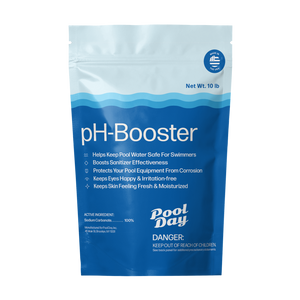
To raise pH: use sodium carbonate (soda ash), such as Pool Day's pH Booster. Add gradually and retest after 2 hours.
-
To lower pH: use muriatic acid or sodium bisulfate. Add with the pump running and retest after a few hours.
-
Add chemicals gradually. It's easier to make a second small adjustment than to correct an overcorrection.
Pool pH affects almost everything: how well your chlorine works, how the water feels on skin and eyes, and how much wear your pool surfaces and equipment take over time. This guide covers testing, raising, and lowering pH in one place with the steps you actually need, in the right order.
What Is the Ideal Pool pH?
pH is measured on a scale from 0 to 14. Below 7 is acidic, above 7 is alkaline, and 7 is neutral. For a swimming pool, the target range is 7.2–7.8, with 7.4–7.6 as the sweet spot.
|
pH Level |
What It Means |
|
Below 7.2 |
Too acidic — corrosive to surfaces and equipment, irritating to swimmers |
|
7.2–7.4 |
Low end of acceptable range |
|
7.4–7.6 |
Ideal — chlorine most effective, water most comfortable |
|
7.6–7.8 |
High end of acceptable range |
|
Above 7.8 |
Too alkaline — chlorine less effective, scaling risk increases |
The range is narrow for a reason. As pH rises, chlorine's sanitizing efficiency can decrease, while higher pH also increases the risk of scale formation.
What Causes Pool pH to Change?
Pool pH is constantly being pushed and pulled by different factors. Understanding what moves it helps explain why you'll always need to test and adjust periodically, no matter how well the pool is maintained.
Things that raise pH:
-
Liquid chlorine (sodium hypochlorite) is a high pH product
-
Cal-hypo shock raises pH when added
-
CO₂ off-gassing and aeration. Waterfalls, spillovers, jets, and other water features accelerate CO₂ loss, which naturally raises pH.
Things that lower pH:
-
Chlorine tablets (trichlor) steadily pull pH down over time
-
Muriatic acid or other pH reducers
Other factors that affect stability:
-
Low total alkalinity makes pH "bounce" and harder to control
-
Heavy bather load such as body oils, sweat, and lotions — a packed pool shifts chemistry faster than an empty one
-
Hot weather and direct sun accelerate chemical reactions
-
Heavy rain can dilute pool water and shift pH and other chemistry, so it's worth retesting afterward.
The type of chlorine you use is one of the biggest variables. For a full breakdown, see Pool Day's Does Chlorine Affect pH? guide.
What Happens If pH Is Too Low or Too High?
pH too low (below 7.2):
-
Eye and skin irritation for swimmers
-
Corrosion of metal fittings, ladders, and heat exchangers
-
Etching of plaster and concrete pool surfaces over time
pH too high (above 7.8):
-
Chlorine's sanitizing efficiency can decrease, making it harder to maintain properly sanitized water
-
Cloudy water and scale buildup on surfaces, tiles, and inside equipment
-
Eye and skin irritation (though less severe than with low pH)
Neither direction is safe to leave unaddressed for long.
How to Test Pool pH
How often: Test pH at least once a week during the swimming season. Test after heavy use, after rain, after adding chemicals, or any time the water looks or feels off.
Test strips vs. liquid kits: Test strips are a practical choice for routine pH checks, and they're quick and accurate enough for this parameter. For greater precision, or if you're troubleshooting a persistent problem, a liquid drop test kit (such as the Taylor K-2006) gives a more accurate reading. Strips are generally more reliable for pH than for total alkalinity or calcium hardness.
How to get a reliable reading:
-
Take your water sample at elbow depth, near the center of the pool, away from the return jets and the skimmer
-
Test promptly — don't let the sample sit in a hot car or direct sunlight before testing
-
Follow the instructions on your test kit exactly as the color comparisons can be subtle
-
If your reading is borderline, test again to confirm before adjusting
Balance Total Alkalinity First
Before adjusting pH, check your total alkalinity (TA). TA is the buffer that stabilizes pH, and when it's in range (80–120 ppm), pH is easier to adjust and holds its position. When alkalinity is in range, pH adjustments are more predictable and the water is better buffered against sudden swings. When alkalinity is low, pH can change more easily in response to rain, chemical additions, or heavy swim sessions.
Key takeaway: I see this mistake constantly: someone adds pH increaser, the pH rises, then drifts back down a day later. Often, the real issue is low alkalinity. Fix that first, and the pH correction is much more likely to hold.
If TA is out of range, adjust it before touching pH. For a full explanation, see Pool Day's Alkalinity vs. pH guide.
How to Raise Low pH
What to use: Sodium carbonate (soda ash). Pool Day's pH Booster is 100% sodium carbonate — add it according to the dosing chart on the bag, or use the Pool Day Calculator for the exact amount based on your pool volume.
Note: sodium bicarbonate (baking soda) also raises pH, but more gently and primarily raises total alkalinity. Use it when both TA and pH are low. Use soda ash when TA is already in range and you just need to raise pH.
Steps:
-
Calculate your dose using the product label or the Pool Day Calculator
-
With the pump running, broadcast the sodium carbonate evenly across the pool surface — no need to pre-dissolve soda ash
-
Run the pump for at least 2 hours before retesting
-
Retest and repeat if needed, adding in small increments rather than large doses
Wait time before swimming: The product label will specify, but generally 2 hours with the pump running is sufficient. Retest pH before anyone gets in.
How to Lower High pH
What to use: Muriatic acid (hydrochloric acid) or sodium bisulfate (dry acid). Muriatic acid is more commonly available and works faster; sodium bisulfate is easier and safer to handle and is a practical alternative.
Safety note: Muriatic acid is corrosive. Wear gloves and eye protection and work in a ventilated area. If the product instructions call for dilution, always add acid to water — never water to acid.
Steps:
-
Calculate your dose based on your pool volume and current pH reading — product labels include dosing charts, or use the Pool Day Calculator
-
With the pump running, add the acid according to the product label, typically in the deep end away from skimmers and pool surfaces.
-
Keep the pump running for at least 4 hours before retesting
-
Retest and repeat if needed. Don't try to correct a large drop in one dose
Wait time before swimming: Test pH before swimming. If it's below 7.2 after treatment, wait and retest — don't add more acid.
For lowering total alkalinity alongside pH, see Pool Day's Muriatic Acid guide.
How pH and Alkalinity Work Together
pH and total alkalinity are related but different. pH tells you how acidic or alkaline your water is. Alkalinity tells you how resistant it is to pH change.
When alkalinity is in range, pH adjustments are predictable — you add a measured dose, the pH moves by roughly the expected amount, and it stays there. When alkalinity is low, pH is unstable and it swings in response to every rainstorm, chemical addition, or heavy swim session, and corrections don't hold.
The practical implication: adjust alkalinity first, then pH. Adjusting alkalinity always has some effect on pH, which is why you should retest pH after any TA correction before deciding whether a separate pH adjustment is needed. Going in the other order wastes time and chemicals.
For the full breakdown, see Pool Day's Alkalinity vs. pH guide.
How Often to Adjust and What to Watch For
Regular testing rhythm: Weekly during the swimming season — at minimum, test chlorine and pH. Test alkalinity, calcium hardness, and CYA monthly.
Test immediately after:
-
Heavy rain or a thunderstorm
-
A large number of swimmers (a pool party, for example)
-
Adding any pool chemical
-
Noticing cloudy water, irritated eyes, or strong chlorine smell
Avoiding overcorrection: Add chemicals in smaller increments and retest before adding more. Large single doses often overshoot. A correction that takes two smaller additions is better than one that pushes pH too far the other way and requires another correction to fix.
If you find yourself constantly adjusting pH without it staying in range, check your total alkalinity first and consider whether your chlorine type is working against you. For more on that, see Pool Day's Does Chlorine Affect pH? guide.
Summary and Key Takeaways
-
Target pH: 7.2–7.8, sweet spot 7.4–7.6
-
Test at least weekly; test immediately after rain, heavy use, or any chemical addition
-
Balance total alkalinity first (target: 80–120 ppm) — it's the foundation that makes pH adjustments hold
-
To raise pH: use sodium carbonate (soda ash). Pool Day's pH Booster and follow the label or use the Pool Calculator for dosing. Retest after 2 hours.
-
To lower pH: use muriatic acid or sodium bisulfate. Add to the deep end with the pump running. Retest after 4 hours.
-
Always add chemicals gradually and retest before adding more. Overcorrection is harder to fix than the original problem.