Alkalinity vs pH: What's the Difference and Why It Matters for Your Pool


If you've ever stared at your pool test results wondering why you need to check both Alkalinity and pH (and whether they're even different things) you're not alone. It's one of the most common points of confusion for pool owners, and honestly, I get it. The two are closely related, the numbers sit next to each other on your test strip, and they even move together when you add certain chemicals.
But they're not the same thing, and treating them like they are is one of the fastest ways to end up chasing your water balance in circles all summer.
I’m not here to give you a chemistry lesson. This is a practical pool owner’s guide to the relationship between pH and Alkalinity as it relates to your water: what each one actually does, how they affect each other, and what to do when either one is off.
Key takeaway:
The most common pH mistake pool owners make is actually not adjusting Alkalinity to be in range! They don't realize how much Alkalinity impacts pH.
Are Alkalinity and pH the Same Thing?
No, Alkalinity is not the same as pH - but they are closely connected, which is where the confusion comes from.
Here's the simplest way to think about it: pH is the measurement that tells you how acidic or basic your water is. Alkalinity is what controls how stable that measurement is. In other words, Alkalinity is the shock absorber or buffer for pH. If your Alkalinity is in range, it makes it much easier to keep your pH in range too.
What pH Means for Your Pool
pH measures how acidic or basic your pool water is, on a scale from 0 to 14. It’s also what impacts chlorine performance and how your water feels when you are in it the most.
For swimming pools, you want to stay between 7.2 and 7.6.
pH is incredibly volatile, and anything you put into your pool can impact it (including leaves, pollen, and swimmers). That’s why it’s so important to test your water regularly, as an off-balance pool can potentially harm your pool or the people swimming in it.
pH too low? Stinging eyes, irritated skin, damage to surfaces and equipment
pH too high? Cloudy water, scale buildup, and chlorine that barely works
What Total Alkalinity Means for Your Pool
Total Alkalinity (often referred to as TA or just Alkalinity) is the buffer that keeps pH from bouncing around - think of it like a bodyguard for pH. When it's in range, small disturbances like environmental debris or lots of swimmers don't throw off your pH.
The ideal Alkalinity range for pool water is 80-120 ppm.
Alkalinity too low? pH swings wildly with every rainstorm, chemical dose, or heavy swim session. You'll be adjusting constantly.
Alkalinity too high? pH locks up and becomes hard to move. Water goes cloudy and scale builds up.
How Alkalinity Affects pH in Practice
Here's the relationship that most pool guides skip over: Alkalinity acts as a buffer for pH.
When Alkalinity is in range, your pH stays relatively stable. A rainstorm rolls in, a bunch of kids jump in the pool, you add some chlorine – and your pH absorbs those changes without swinging all over the place. You test, maybe make a small adjustment, and you're done.
When Alkalinity is too low, the opposite happens. Your pH has no buffer. Every little thing knocks it off course. You add pH increaser, it goes too high. You add pH decreaser, it drops too fast. You're constantly reacting rather than maintaining.
This is why you should always get your Alkalinity right before worrying about pH. If the foundation isn't stable, nothing you do to the pH will stick.
Key takeaway:
Get Alkalinity right first, then adjust pH. And remember that adjusting Alkalinity changes pH, so re-test after adjusting Alkalinity before adjusting pH.
Does Raising Alkalinity Raise pH?
Usually yes, though not always dramatically.
Most Alkalinity increasers (sodium bicarbonate) have a moderate effect on pH. Adding Alkalinity increaser to low-Alkalinity water will often nudge your pH upward slightly. That's one reason the order in which you adjust matters.
If your Alkalinity is low and your pH is also low, correcting the Alkalinity first may bring your pH close to range without needing a separate pH adjustment. Test after adjusting Alkalinity before assuming you still need to touch the pH.
If your Alkalinity is low but your pH is already in range, you'll need to be careful, as raising Alkalinity too aggressively can push pH above your target. Add Alkalinity increaser gradually and retest.
Alkalinity Increaser vs pH Increaser: Are They the Same?
No. They are different products that do different things, even though both raise numbers on your test results.
Alkalinity increaser is sodium bicarbonate (aka baking soda). It raises total Alkalinity with a modest effect on pH. Use it when your Alkalinity is below 80 ppm.
pH increaser (sometimes called pH Up) is typically sodium carbonate (soda ash). It raises pH more directly and aggressively, with a stronger effect on pH than on Alkalinity. Use it when your Alkalinity is already in range but your pH is running low.
They are not interchangeable. Using pH Up to fix low Alkalinity won't work properly, and using Alkalinity increaser when you really just need to raise pH can push your Alkalinity too high while not moving the pH enough.
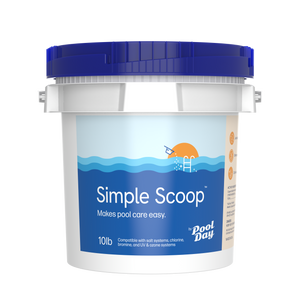
The shortcut: If you're looking to simplify your routine, a product like Simple Scoop is designed to handle multiple water balance needs in one scoop without juggling a ton of separate bottles. It's a good option for pool owners who want to maintain balanced water without managing a shelf full of individual products.
How do I lower pH or Alkalinity?
So far we've covered what to do when numbers are low. But both Alkalinity and pH can run high too, and here’s the solution.
If pH is too high, you need a pH decreaser (also called pH Down). The active ingredient is typically muriatic acid or sodium bisulfate. Add it gradually with the pump running and retest after a few hours.
If Alkalinity is too high, you also use a pH decreaser - the same product. The difference is in how you apply it. Adding it in one concentrated dose to a small area, rather than broadcasting it evenly, is more effective at bringing Alkalinity down without tanking your pH at the same time.
One thing to keep in mind: lowering Alkalinity takes more patience than raising it. You may need to do it in stages over a couple of days rather than correcting it all at once.
Which Do You Adjust First?
Always adjust Alkalinity first, then pH.
Here's why: Alkalinity is the foundation that determines how your pH behaves. If you adjust pH first, you're trying to stabilize a number on an unstable platform. Any progress you make is likely to slip.
The correct sequence:
-
Test both Alkalinity and pH.
-
Adjust Alkalinity if it's outside 80-120 ppm. Use Alkalinity increaser if it's low.
-
Wait and retest. Allow the water to circulate (leave pump and filter on) for one hour, then check both numbers again.
-
Adjust pH only after Alkalinity is in range. Small corrections at this stage tend to hold much better.
Skipping the re-test between steps is the most common mistake. Give each adjustment time to fully mix before deciding what to do next.
Key takeaway:
Going too fast is the most common mistake pool owners make. Don't expect to fix everything in one step. Adjust Alkalinity first, taking multiple steps and re-testing after each one. Then adjust pH in the same manner.
In Summary
-
pH measures how acidic or basic your water is. Target: 7.2-7.6. Affects swimmer comfort, chlorine effectiveness, and equipment lifespan.
-
Total Alkalinity measures your water's resistance to pH change. Target: 80-120 ppm. Low Alkalinity causes pH to swing constantly; high Alkalinity locks pH in place and promotes cloudiness.
-
They work together, but aren’t the same. Alkalinity stabilizes pH. Get Alkalinity right first and pH becomes much easier to manage.
-
Raising Alkalinity can raise pH slightly, which is why order matters: fix Alkalinity first, retest, then address pH if needed.
-
Alkalinity increaser and pH increaser are different products. Don't substitute one for the other.
-
But decreasing Alkalinity and pH is done with the same products.
-
Adjust Alkalinity before pH, always. And retest between adjustments.
When both are in range, maintaining your pool gets a lot simpler. Products like Simple Scoop can help you keep everything balanced without the guesswork.