Why Is My Pool Cloudy? Causes and How to Fix It


Article TLDR:
Cloudy pool water is almost always caused by one of five things:
- a chemistry imbalance (pH, alkalinity, or calcium hardness out of range)
- low or depleted chlorine
- a filter that isn't keeping up
- environmental factors like rain or lots of swimmers
- early-stage algae
The fix is always the same: test first, correct in order, run your filter. Don't add chemicals until you know what's actually wrong.
Cloudy pool water is one of the most common issues we hear from pool owners. If your pool is cloudy, milky, or generally unclear, it’s not the end of the world.
Instead of panicking and reaching for chemicals, the first thing you should do is test your water. Once you know what's actually off, the fix is usually straightforward, and we'll walk you through exactly how to do it in this article.
Key takeaway: I can't tell you how many times I've seen someone dump a bunch of chemicals into a cloudy pool and hope for the best. It never works. Test first, figure out what's actually wrong, then fix it. In that order. Every time.
What Does Your Pool Water Look Like?
Before you even reach for a test strip or run to the pool store, how your water looks can tell you a lot. Not all cloudiness is the same, and narrowing it down visually will save you time and money.
Dull or hazy, but you can still see the bottom. This is the mildest form of cloudiness. Usually a sign of minor pH or alkalinity drift, early-stage chlorine depletion, or simply a filter that needs a little attention. Often this clears up with a chemistry correction and extended time with your pump running.
Cloudy or milky white, can't clearly see the deep end. A milky pool is typically a calcium hardness issue, high pH, or high alkalinity causing calcium carbonate to precipitate out of the water, aka dissolved minerals becoming visible particles. It can also be a sign of a filter working overtime and losing the battle.
Cloudy with a green or blue-green tint. A green tint almost always points to early-stage algae, even if you don't see growth on the walls yet. The cloudiness is actually millions of algae cells suspended in the water.
Cloudy after a pool party or heavy rain. If your pool is suddenly murky after a busy weekend or a big storm, it usually means your pool water is reacting to extra debris. Sunscreen, sweat, body oil, and environmental gunk like leaves can throw off your chemistry and tax your filter.
Common Causes of Cloudy Pool Water
pH Imbalance
pH is the foundation of water balance and it impacts everything, including how clearly you can see the bottom of your pool.
High pH (above 7.8) is one of the most common causes of milky or cloudy water. When pH climbs too high, calcium carbonate becomes less soluble and starts to precipitate out of the water as fine white particles, which is why high-pH pools often look cloudy or milky. High pH also dramatically reduces the effectiveness of your chlorine, meaning contaminants that should be getting oxidized are not, hanging around in the water and adding to the haziness.
Low pH (below 7.2) is less likely to cause cloudiness on its own, but it can contribute indirectly. Highly acidic water corrodes pool surfaces and equipment, releasing fine particles into the water, and it can throw off your alkalinity and calcium hardness in ways that cause cloudiness.
Target pH of 7.2-7.6 (slightly above neutral) for the clearest, most comfortable water.
Alkalinity Out of Range
Total Alkalinity (TA) acts as a buffer for your pH, and it's what stops your pH from swinging wildly every time it rains or someone jumps in the pool. Getting it wrong in either direction causes real problems for water clarity.
High alkalinity (above 120 ppm) causes the same calcium carbonate precipitation issue as high pH, often producing that characteristic milky or cloudy appearance. It also makes pH harder to adjust, which means even when you add a pH reducer, the reading keeps creeping back up – a frustrating loop that many pool owners find themselves stuck in. If your pool looks cloudy and your pH keeps resisting correction, high TA is often the hidden culprit.
Low alkalinity (below 80 ppm) destabilizes your pH and causes it to bounce around unpredictably, a condition sometimes called "pH bounce." When pH is unstable, chlorine efficiency drops, and those wild swings can cause enough chemistry disruption to cloud the water. Low TA is a surprisingly common cause of the "my chemistry looks fine but my pool is still cloudy" problem, because by the time you test, the pH may have temporarily swung back to a normal-looking reading.
Target range: 80-120 ppm, with 100 ppm being a solid sweet spot for most pools.
Calcium Hardness
Calcium hardness, or the measure of how much dissolved calcium is in your water, gets overlooked more than almost any other parameter, but it has a direct impact on water clarity.
High calcium hardness (above 400 ppm) means there's more calcium dissolved in your water than it can comfortably hold. Combine that with even slightly elevated pH or alkalinity and you'll get calcium carbonate precipitation: the fine white haze that gives pools that milky, uninviting look. In extreme cases you might also see scaling on surfaces and equipment.
Low calcium hardness (below 200 ppm) is a lesser-known cause of cloudy water, but a real one. Water that's low in calcium is chemically "hungry", meaning it will actively seek minerals to dissolve, eating calcium from your pool's plaster, grout, and equipment surfaces. This can release fine particles and dust into the water, causing cloudiness that has nothing to do with your sanitizer levels.
Target range: 200-400 ppm.
Low or Depleted Chlorine
Chlorine is your pool's primary defense against bacteria, contaminants, and algae. When it drops too low, organic matter starts to accumulate in the water faster than it can be oxidized, and the result is hazy, dull water that just doesn't look right.
A pool with chronically low chlorine will also start developing chloramines, combined chlorine compounds that form when free chlorine reacts with things like sweat, urine, and body oils. Chloramines are far less effective than free chlorine, and they contribute to cloudiness, that familiar "pool smell," and eye irritation.
If your pool smells strongly of chlorine but the water is still cloudy, chloramines are likely the issue. In this case, that strong smell means not enough active chlorine, not too much.
Poor Filtration or Circulation
Even perfectly balanced water will go cloudy if your filter isn't doing its job. The filter and pump are what physically remove fine particles from the water, and without that mechanical action, suspended debris just stays suspended.
The most common filtration mistakes we see:
- Not running the pump long enough. Most pools need 8-12 hours of filtration per day during swim season, and even more (16 hours+) during hot weather or heavy use. Running it for a few hours and expecting crystal clear water isn't realistic.
- A dirty or clogged filter. A filter that's past due for backwashing (for sand or DE filters) or cartridge cleaning is actually putting particles back into the water rather than removing them. Make sure to remove any debris buildup in your skimmer and pump basket as well.
- Undersized equipment. If your pool pump or filter is too small for your pool volume, it may simply not be able to keep up with the amount of water, especially in warm weather when algae and bacteria grow faster. Check your pump and filter instructions for the recommended pool volume. If your pool is bigger that, upgrading to the right size equipment will make a world of difference.
If your chemistry is spot-on but the water is still cloudy, your filter is almost always where to look next.
What do I do if my filter isn’t keeping up?
-
Start by cleaning or backwashing your filter. For sand and DE filters, backwash until the sight glass runs clear. For cartridge filters, remove and rinse thoroughly with a garden hose from top to bottom.
- If it has been more than a season since a deep clean, soak in filter cleaning solution overnight.
- After cleaning, run your pump for a full 12-hour cycle. If water clarity improves but isn’t great, your pump may not be turning over your pool volume fast enough.
- As a general rule, your pump should cycle your entire pool volume at least once every 8 hours.
- If your filter and pump are all set, but the water still won't clear, it may be time to look at the filter media itself. Sand filters should have their sand replaced every 3 to 5 years. DE filter grids wear out and can crack over time, letting fine particles pass through. Cartridge filters that have been cleaned repeatedly eventually lose their ability to trap fine particles even when they look okay visually. If your filter is old and you've exhausted everything else, the media or the cartridge itself may simply be done and need to be replaced.
Environmental Factors and Bather Load
Sometimes cloudiness has nothing to do with negligence, and more to do with the world around it.
Heavy rain introduces phosphates, dirt, debris, and dilutes your chemical balance. High pollen seasons can coat your pool with fine organic particles that overwhelm the filter. And a pool party with many people introduces a significant load of body oils, sunscreen, sweat, and other organics all at once.
What should I do after a storm of a big party?
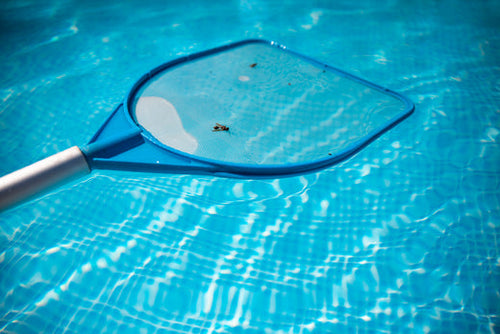
- Start by skimming visible debris, then test your water. Rain dilutes and unbalances chemistry, and a heavy bather load burns through chlorine fast, so don't assume your levels are still where you left them.
- Review test results and correct any chemistry imbalances. Start with alkalinity, then pH.
- If chlorine is low, shock using a full dose based on your pool volume. If it’s still in range, a maintenance dose is enough.
- Retest before anyone gets back in.
Early-Stage Algae
Algae doesn't announce itself. Long before you see green growth on the walls, you'll often notice a general loss of water clarity. It’ll have a dull, slightly hazy look that doesn't quite respond to chemistry adjustments the way normal cloudiness would.
The giveaway is usually a faint green or blue-green tint to the water. Chemistry-based cloudiness is almost always white or milky. If there's any green to it, treat it as an algae problem. If you can see the algae, you've already lost a day or two of easy treatment window.
How do I get rid of early-stage algae?
- Test and correct any chemistry imbalances, particularly pH, since high pH reduces chlorine's effectiveness against algae.
- Shock with 3-4 lbs of Calcium Hypochlorite (Cal-Hypo) shock per 10,000 gallons of water, ideally at dusk so UV light doesn't break it down before it can work.
- Brush the walls and floor before and after shocking to break algae loose from surfaces.
- Run your pump and filter continuously and backwash partway through to avoid recirculating dead algae cells. If the water hasn't improved within 24 to 48 hours, a second shock treatment or algaecide may be needed.
How to Fix Cloudy Pool Water: Step by Step
Don't reach for the shock before you know what's wrong. The most effective fix follows a logical sequence:
- Test your water first. Grab a reliable test strip or kit. You're looking at Total Alkalinity, pH, Calcium Hardness, and Free/Combined Chlorine before you do anything else.
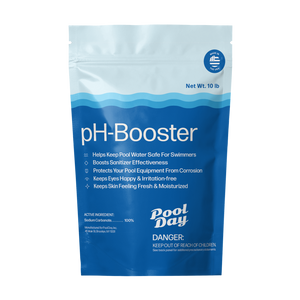
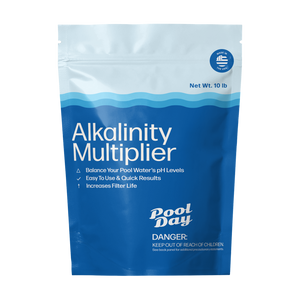
- Correct chemistry imbalances. Start with alkalinity first, then pH, then calcium hardness. Chlorine last. Adjusting one affects the others, so sequence matters. Pool Day's pH and alkalinity adjusters are straightforward to use and include dosing guidance for common pool sizes.
- Run your filter (for longer than you think). After any chemistry correction, run your pump and filter for a minimum of 8-12 hours. Many cloudiness issues clear up with nothing more than this.
- Shock if needed. If chlorine is depleted, you have combined chlorine, or you're dealing with early-stage algae, a good shock treatment is the reset your pool needs. For algae, use 3-4lbs of Calcium Hypochlorite (Cal-Hypo) Shock per 10,000 gallons of pool water, and run your pump for at least 24.
- Use a flocculant or clarifier for residual cloudiness. If the chemistry is right and the filter is running but there's still a slight haze, use a fix like a clarifier or flocculant. Clarifiers work by coagulating fine suspended particles into larger clumps your filter can catch. A flocculant does the same but settles particles to the floor that you can then vacuum. For full detail on which to use when, check out our clarifier vs. flocculant guide.
- Vacuum and retest. If you've used a flocculant or had significant debris settling, vacuum to waste (bypassing the filter). If you vacuum on ‘filter’, all that gunk will just come right back out the jets. Then retest your chemistry and confirm everything is back in range.
Key takeaway: Alkalinity first, then pH, then calcium, then chlorine. I know it seems like it shouldn't matter but it really does. Follow the right order and you'll be fine. If you don’t, it will be like playing whac-a-mole (not in a good way).
My Pool Is Balanced But Still Cloudy - What Now?
This is one of the most common and frustrating situations pool owners find themselves in. Chemistry looks right, chlorine is in range, but the water is still cloudy. Here's what to check:
Look harder at your alkalinity. TA in the 80-120 range is the target, but chemistry doesn't lie. If it was way off recently and you corrected it, there may be residual particulate matter still clearing through the filter.
Check your filter. Then check it again. A filter that looks clean on the surface may be channeled (water finding a path through rather than filtering properly) or simply overwhelmed. Try a deep clean or backwash and run your pump longer.
Consider your calcium saturation index. If pH, TA, and calcium hardness are all at the high end of their respective normal ranges simultaneously, you can be technically "balanced" on each individual parameter but still have water that's prone to precipitation and cloudiness. A digital tester or drop-based kit will give you more precise readings, and the fix is simple: bring whichever parameter is highest back toward the middle of its target range.
Add a clarifier. If everything else checks out and cloudiness is minor, a pool clarifier can be a quick fix. It won't completely solve the problem if something is genuinely wrong, but it's the right tool for cleaning up residual fine-particle cloudiness that the filter is struggling to remove on its own.
How to Prevent Cloudy Pool Water
The pool owners who never seem to have cloudy water aren't doing anything special to their water. They're just consistent, and they’re doing this:
Test twice a week during swim season. Chemistry drifts faster when it's hot and the pool is getting heavy use. A quick test on Wednesday and Saturday catches problems before they become visible.
Run your pump 8-12 hours daily. Non-negotiable. Set a timer and forget about it.
Shock after heavy use. A maintenance shock, especially after a pool party or heavy rainstorm, makes a real difference over the season.
Use a pool cover when the pool isn't in use. This single habit dramatically reduces debris load, slows evaporation (which concentrates chemistry), and keeps pollen and rain out.
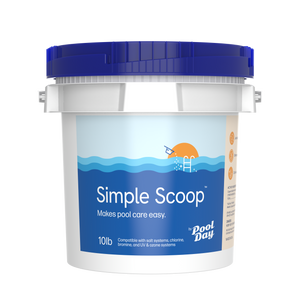
Simplify your chemical routine. A big reason chemistry falls out of balance is that pool owners are juggling too many products and losing track of what they've added. Pool Day's Simple Scoop is built around exactly this problem: an all-in-one maintenance product that combines algaecide, non-chlorine shock, clarifier, and stain and scale protection. One scoop, and most of the hard work is done.
Why Is My Pool Cloudy After Shocking?
A little cloudiness right after shocking is actually normal! The shock is doing its job, oxidizing contaminants and stirring things up. It should clear within a few hours to a day with the pump running.
If cloudiness persists beyond 24-48 hours after shocking, something else is going on. Whether it’s pH that's too high (reducing shock effectiveness), a filter that needs attention, or an underlying algae issue that one shock treatment wasn't enough to resolve, we can help you get back to 100% perfect water in this in-depth guide.
Closing
Cloudy water is almost never a crisis, but it is your pool telling you something needs attention. The fix is almost always the same: test first, correct in the right order, run your pump and filter, and give it time to work.
If you want to make the whole process simpler, Pool Day products are designed to take the guesswork out of it. Simple Scoop's all-in-one formula is built for real pool owners who want to maintain crystal clear water without a chemistry degree.