Calcium Hardness in Pools: What It Is and How to Get It Right


Article TLDR:
-
Calcium hardness (CH) measures the amount of dissolved calcium in your pool water. The ideal range is 200–400 ppm for most pools.
-
Too low: water becomes aggressive, increasing the risk of etching plaster and concrete surfaces and contributing to corrosion of metal components.
-
Too high: calcium deposits as scale on surfaces, tiles, and inside equipment.
-
Raise CH with calcium chloride according to the product label. High-purity products typically raise CH by about 10 ppm per pound per 10,000 gallons.
-
To lower CH, drain a portion of the pool and refill with fresh water. There's no chemical alternative.
-
Test monthly as CH is one of three core water balance factors alongside pH and total alkalinity.
Calcium hardness doesn't get as much attention as pH or chlorine, but it quietly affects your pool's surfaces and equipment more than most people realize. Get it right and you'll avoid two of the most expensive pool problems: corrosion and scale. This guide covers what calcium hardness is, what the right levels look like for your pool type, and exactly how to test and adjust it.
What Is Calcium Hardness?
Calcium hardness is a measure of how much dissolved calcium is in your pool water. It's one of three core factors in overall water balance, alongside pH and total alkalinity.
It's worth distinguishing calcium hardness from total hardness. Total hardness includes all dissolved minerals in the water, including magnesium. Pool chemistry focuses specifically on calcium hardness, and most pool test kits that say "hardness" are measuring calcium hardness unless they explicitly state otherwise.
Calcium hardness is also a key input into the Langelier Saturation Index (LSI), which pool professionals use to assess whether water is corrosive or scale-forming overall. Without getting into the math, the principle is simple: water always wants to reach chemical equilibrium. If it doesn't have enough dissolved calcium, it can dissolve calcium from plaster, concrete, and grout while also increasing the risk of corrosion to certain metal components. If it has too much, the excess deposits itself on every surface it touches.
What Should Calcium Hardness Be in a Pool?
Surface type affects where in the range you should aim:
-
Plaster and concrete pools: 200–400 ppm, with 250–350 ppm as a comfortable target. These surfaces are calcium-based, so they're the most vulnerable to corrosive water.
-
Vinyl liner pools: 150–250 ppm. Vinyl surfaces don't require calcium for structural protection, but maintaining moderate hardness helps support overall water balance and protect equipment.
-
Fiberglass pools: 150–250 ppm. Fiberglass is less susceptible to calcium-related surface damage than plaster, but maintaining balanced hardness helps support proper water chemistry. Some fiberglass manufacturers recommend keeping calcium hardness toward the lower end of this range to reduce the risk of cosmetic scaling on the gelcoat, so check your owner's manual for any manufacturer-specific recommendations.
For spas and hot tubs, the same general ranges apply, but heat accelerates calcium precipitation, meaning calcium deposits form faster at high temperatures. If you have a spa or pool heater, aim toward the lower end of your acceptable range to reduce scale risk inside the heater, which is one of the more expensive components to service.
What Happens If Calcium Hardness Is Too Low?
Low calcium hardness, generally below 200 ppm for plaster pools, makes your water chemically aggressive. Water without enough dissolved calcium will pull it from wherever it can find it. For pool owners, that means:
-
Plaster and concrete surfaces start to pit and etch as the water dissolves calcium directly from the material. This is cumulative so while you won't see it right away, over months and seasons it shortens the life of your plaster significantly.
-
Grout between tiles deteriorates in the same way, eventually loosening tiles.
-
Low-calcium, poorly balanced water can also contribute to corrosion of metal fittings, ladders, and heat exchangers, particularly when paired with low pH.
Vinyl liner pools are less susceptible to surface etching since there's no calcium-based material for the water to dissolve. However, poorly balanced water can still contribute to corrosion of metal fittings and equipment over time.
What Happens If Calcium Hardness Is Too High?
Above about 400 ppm, the risk of calcium scale increases, especially if pH or total alkalinity are also high. The excess starts depositing itself, known as scaling, and it shows up:
-
As a white or grey crust on waterline tiles, pool walls, and around fittings
-
As cloudiness in the water, caused by calcium particles suspended or precipitating out of solution
-
Inside pool equipment (e.g. filters, heaters, and pump impellers) where scale buildup restricts flow, reduces efficiency, and can cause equipment failure
Scaling damage compounds over time. A heater element coated in calcium scale transfers heat less efficiently, increasing wear over time and potentially shortening the heater's lifespan. The fix is expensive compared to keeping calcium in range in the first place.
How to Test Calcium Hardness
Test calcium hardness at least once a month during swimming season, and after any significant water addition such as heavy rain, refilling after draining, or a partial drain-and-refill.
For routine monitoring, test strips can give you a quick estimate of calcium hardness. If you're making a significant chemical adjustment or troubleshooting ongoing water balance issues, a liquid drop test kit provides a much more accurate and repeatable reading. The Taylor K-2006 is widely considered the industry standard.
When testing:
-
Take your sample at elbow depth, near the center of the pool — away from return jets and the skimmer
-
Test the sample promptly. Don't let it sit for more than a few minutes before testing.
-
If your reading is close to the recommended range limits, repeat the test to confirm before adding any chemicals.
How to Raise Calcium Hardness
The only way to raise calcium hardness is to add calcium chloride, sold as calcium hardness increaser.
Dosing depends on the product concentration. High-purity calcium chloride products typically raise calcium hardness by about 10 ppm per pound per 10,000 gallons, while lower-concentration products (such as 77% flake calcium chloride) require about 25% more product. Always follow the product label when calculating your dose.
Use this table to find your dose:
|
Pool Size |
Raise by 10 ppm |
Raise by 25 ppm |
Raise by 50 ppm |
|
10,000 gal |
1 lb |
2.5 lb |
5 lb |
|
15,000 gal |
1.5 lb |
3.75 lb |
7.5 lb |
|
20,000 gal |
2 lb |
5 lb |
10 lb |
|
30,000 gal |
3 lb |
7.5 lb |
15 lb |
|
40,000 gal |
4 lb |
10 lb |
20 lb |
|
50,000 gal |
5 lb |
12.5 lb |
25 lb |
How to add it correctly:
-
Calculate your dose using your pool volume and the product label.
-
Turn the pump on to ensure good circulation.
-
Add the calcium chloride according to the manufacturer's instructions. Some products are designed to be broadcast directly into the pool, while others recommend pre-dissolving before use.
-
If broadcasting directly, spread the product evenly across the pool and brush any undissolved granules off the floor, especially in vinyl and fiberglass pools.
-
If raising CH by more than 30–40 ppm, split the adjustment into two treatments 24 hours apart to minimize temporary cloudiness.
-
Run the pump for 4–6 hours before retesting.
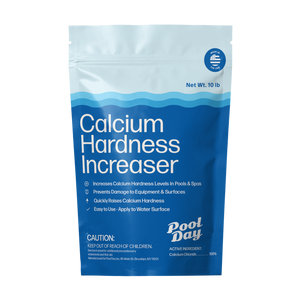
Pool Day's Calcium Hardness Increaser is a good option here and for precise dosing based on your pool's exact volume, use the Pool Day calculator.
How to Lower Calcium Hardness
There is no chemical that removes calcium from pool water at any meaningful scale. The only reliable method is dilution: drain a portion of the pool and refill with lower-calcium water.
Partial drain and refill:
-
Test your fill water first. If your tap water comes in at 200 ppm, draining and refilling won't solve the problem
-
Drain 25–50% of the pool water (the higher the current CH, the more you'll need to drain)
-
Refill and retest before deciding if a second drain is needed
-
The math: if CH is 600 ppm and fill water is 100 ppm, draining 50% and refilling brings you to approximately 350 ppm — back in range
If your tap water is itself very hard, draining and refilling won't get you far. In that case, mixing in some softened or reverse-osmosis water during the refill can help, or contacting a pool water delivery service that provides pre-treated water. Alternatively, if your fill water is consistently very hard, a portable water softener or a hose-mounted filter designed to reduce hardness can help lower the amount of calcium added during refills.
How Calcium Hardness Interacts With pH and Alkalinity
Calcium hardness doesn't exist in isolation: it's one input in the overall water balance equation alongside pH and total alkalinity.
The practical implication: the same CH reading can behave differently depending on where your pH and alkalinity sit. At a higher pH, calcium is more likely to precipitate out of solution and form scale, even at CH levels that would be fine at a lower pH. At a lower pH, water is more aggressive toward surfaces even if CH is within range.
This is the basic principle behind the LSI — your water's tendency to corrode or scale isn't determined by any single number but by how CH, pH, and alkalinity interact together. I'd suggest treating water balance as a system rather than three separate dials to tune independently. When CH is out of range, check total alkalinity and pH before adjusting calcium hardness. You'll want to correct alkalinity first, then pH, before deciding whether CH still needs to be adjusted.
Summary and Key Takeaways
-
Ideal CH range: 200–400 ppm for plaster/concrete pools; 150–250 ppm for vinyl; and 150 ppm or lower for fiberglass (depending on manufacturer guidelines).
-
Too low causes corrosion and surface damage; too high causes scale and equipment wear
-
Test monthly, ideally with a liquid kit for more significant chemical adjustments
-
Raise with calcium chloride using the product label for dosing; high-purity products typically raise CH by about 10 ppm per pound per 10,000 gallons.
-
Lower by partial drain and refill — there is no chemical shortcut
-
CH works alongside pH and alkalinity; don't adjust it in isolation