Pool Clarifier vs Flocculant: What’s the Difference?


Article TLDR:
-
Both clarifiers and flocculants clear cloudy pool water, but they work differently and aren't interchangeable.
-
Clarifier works with your filter — it clumps fine particles together so the filter can catch them. Check the product label for swim time; Pool Day's Sapphire Super Clarifier is safe to swim in immediately.
-
Flocculant (also called floc or pool flock) is better suited for heavier cloudiness — it sinks particles to the pool floor, which you then vacuum out manually. It can produce faster results in severe cases, but requires more effort.
-
Use clarifier for routine cloudiness. Use flocculant for severe cloudiness when you need a more aggressive treatment and can vacuum the settled debris to waste.
-
Don't overdose clarifier as too much causes the opposite effect and makes water cloudier.
-
Flocculant requires a system that can vacuum directly to waste, bypassing the filter. Sand and DE systems commonly support this, while most cartridge-filter setups do not.
If your pool water is cloudy and you're trying to figure out whether to reach for a clarifier or a flocculant, you're in the right place. Both products fix the same problem, but they use different approaches — and choosing the wrong one for your situation means more work and slower results. This guide explains how each product works, when to use which, and how to apply them correctly.
If you're not sure what's causing your cloudy water in the first place, see Pool Day's Why Is My Pool Cloudy? guide first.
What Is a Pool Clarifier?
A pool clarifier uses coagulating polymers to cause tiny suspended particles in the water to clump together into larger groups. Those larger clumps are then caught by your pool filter in the normal course of filtration. You add it to the pool, keep the pump running, and the filter does the work.
Clarifiers work on fine particles that are too small for a filter to catch on their own — things like body oils, sunscreen residue, fine dust, and dead algae particles. When you're dealing with that hazy, slightly milky look that won't clear up despite balanced chemistry and normal filtration, a clarifier is usually what moves things along.
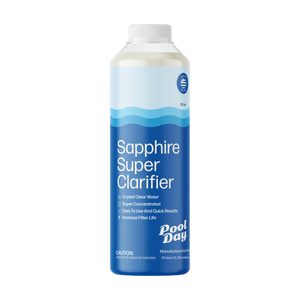
Pool Day's Sapphire Super Clarifier is super-concentrated — 2 oz per 10,000 gallons, with up to 16 uses per 32oz bottle. You can add it near a return jet or into the skimmer, and it's safe to swim immediately after application.
One important warning: don't overdose. Too much clarifier can actually reverse the effect — instead of clumping particles into groups the filter can catch, excess clarifier can coat fine particles and make them harder to filter out, resulting in cloudier water than you started with. Follow the dosing instructions on the label.
What Is a Pool Flocculant?
A pool flocculant (sometimes called floc or pool flock) works on a similar principle as a clarifier but takes the process further. Instead of creating small clumps that the filter catches gradually, flocculant creates large, heavy clumps that sink rapidly to the pool floor. You then vacuum the settled debris out manually.
Because you're removing the particles entirely rather than relying on the filter to catch them, flocculant is faster and more effective for severe cloudiness. It's an option when the water is heavily clouded — after a major storm, after treating a severe algae bloom when large amounts of dead algae remain suspended, or when the pool has been neglected for an extended period.
The tradeoff is effort: floccing a pool requires manual vacuuming directly to waste (bypassing the filter), which takes time and causes you to lose some water in the process.
Filter compatibility is critical: flocculant requires a system that can vacuum directly to waste, bypassing the filter. Sand and DE systems commonly have this capability, while most cartridge-filter setups do not unless they're plumbed with a separate waste line.
What's the Difference?
|
Clarifier |
Flocculant |
|
|
How it works |
Clumps particles for the filter to catch |
Sinks particles to the floor for vacuuming |
|
Best for |
Routine or mild cloudiness |
Severe cloudiness, post-storm, cleanup after a treated algae bloom |
|
Effort required |
Low — filter does the work |
High — requires manual vacuuming to waste |
|
Speed |
Hours to overnight |
Faster initial result, but vacuuming takes time |
|
Filter compatibility |
All filter types |
Sand and DE filters preferred; most cartridge setups aren't compatible |
|
Swimming during treatment |
Depends on product; Pool Day's clarifier is safe immediately |
No — wait until vacuuming is complete |
|
Water loss |
None |
Some — vacuuming to waste removes pool water |
Which Should You Use?
Use clarifier when:
-
Your water has a mild haze or slight cloudiness
-
Chemistry is balanced but the water just isn't clearing up
-
You want a low-effort, hands-off fix
-
You have a cartridge filter without a way to vacuum directly to waste
Use flocculant when:
-
The water is heavily clouded and you can't see the bottom
-
You need results faster than a clarifier can deliver
-
You're cleaning up after a major storm or a treated algae outbreak with lots of suspended debris
-
Your system can vacuum directly to waste and you have a manual vacuum
Key takeaway: When in doubt, start with clarifier. It's less work, it works with any filter, and it handles the vast majority of situations pool owners actually run into. Flocculant is there for when things are genuinely severe — you'll know when you need it.
How to Use a Pool Clarifier
-
Test and balance your water chemistry first. If pH, alkalinity, or chlorine are off, fix those before adding clarifier — clarifier won't solve a chemistry problem, and unbalanced water reduces its effectiveness.
-
Calculate your dose using the product label. For Pool Day's Sapphire Super Clarifier, that's 2 oz per 10,000 gallons.
-
Add the clarifier near a return jet or through the skimmer with the pump running.
-
Run the pump continuously for at least 8–12 hours. The longer the pump runs, the more the filter can capture.
-
Clean or backwash your filter after treatment — it will have captured more debris than usual and will need it.
-
Retest if cloudiness persists after 24 hours. A second dose may be needed for more stubborn cases, but don't exceed the label guidance.
How to Use a Pool Flocculant
-
Test and balance your water chemistry first. Same principle as with clarifier — fix chemistry before adding flocculant.
-
Set your filter to recirculate (bypasses the filter media). This distributes the flocculant through the pool without pulling it into the filter before it has time to work.
-
Add the flocculant according to the product label and allow it to circulate on the recirculate setting for the specified amount of time.
-
Turn the pump off and let the pool sit undisturbed for 8–12 hours, or according to the product label, so the debris can settle to the floor.
-
Vacuum to waste — set your multiport valve to "waste" so the debris goes out of the system rather than back through the filter. Vacuum slowly along the pool floor. If you disturb the settled debris too quickly, it will cloud the water again and you'll need to let it resettle.
-
Refill the pool to compensate for the water lost during vacuuming.
-
Return the system to normal filtration, refill as needed, and retest and rebalance the water. Backwash or clean the filter if the product label or filter pressure indicates it's needed.
Most cartridge-filter setups aren't suitable for flocculant because they don't have a waste setting. Unless your system has a separate way to vacuum directly to waste, use a clarifier and run the pump on extended cycles, or consult a pool professional.
Common Questions
Is clarifier the same as flocculant? No. Both group particles together, but clarifier creates small clumps for your filter to catch gradually, while flocculant creates large clumps that sink to the floor for manual removal. They work differently and suit different situations.
Can you use clarifier and shock together? Generally, yes, but don't add them at the exact same time unless the product labels say they're compatible. Shock first and allow it to work as directed before adding clarifier, since high chlorine levels can affect some clarifier formulas. For more on troubleshooting cloudy water after shocking, see Pool Day's Why Is My Pool Cloudy After Shocking? guide.
How soon can you swim after adding clarifier? Pool Day's Sapphire Super Clarifier is safe to swim in immediately after application. Check the label on any other brand, as formulas vary.
How soon can you swim after using flocculant? Wait until you've completed vacuuming and the water is clear before swimming.
Summary and Key Takeaways
-
Clarifier: low effort, works with any filter, and is best for routine or mild cloudiness. Follow the product label for swim time, and don't overdose.
-
Flocculant: more aggressive, requires manual vacuuming to waste, and is best for severe cloudiness. Your system must be able to vacuum directly to waste.
-
Most everyday cloudiness situations are handled by clarifier. Reach for flocculant when the problem is severe.
-
Always balance water chemistry before adding either product.
-
For routine weekly use, Pool Day's Sapphire Super Clarifier is super-concentrated and safe to use immediately.
-
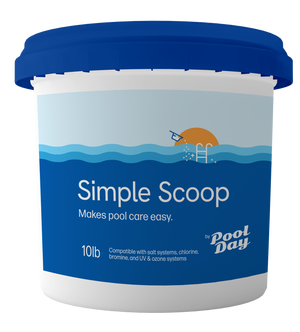
If you'd rather prevent cloudy water before it starts, Simple Scoop includes a clarifier as part of its weekly all-in-one routine alongside your sanitizer.